Your Lovable or Replit app works in the demo. Here is what breaks in production
By Unas Zubair (opens in a new tab), CEO and Co-Founder5 min read
Apps built with Lovable, Replit or Bolt usually break in the same few places once real users arrive: who can see which data, logins, payments, deployment and speed. A vibe coded app rescue fixes those first, starting with a short code audit, before anyone adds a new feature.
These tools are very good at producing a working demo in days. The trouble starts when the demo becomes a product with paying customers, private data and many users at once. This article lists the problems we find most often and explains how to tell whether your app needs help.
Why does an app that works in the demo fail with real users?
A demo is used by one person, with test data, following the steps the builder had in mind. Real use is different. Many people sign in at once, some try things nobody planned for, and a few will look for weaknesses on purpose.
AI app builders write code to satisfy the prompt in front of them. They rarely plan for the hundredth user, the expired card or the curious visitor who opens the browser’s developer tools. So the app passes every test its builder can think of and still fails in public.
What breaks most often?
1. Data that anyone can read. Many Lovable and Bolt apps keep their data in Supabase, which protects each table with access rules called row level security. When those rules are missing or too loose, anyone holding the app’s public key can read other users’ records. That key ships inside every copy of the app’s front end. In May 2025 a security researcher reported that more than 170 Lovable-built apps exposed names, emails, payment status and API keys for this reason. The flaw was recorded as CVE-2025-48757 (opens in a new tab).
2. Logins and roles that only half work. Sign-up and sign-in usually work. Password resets, email confirmation, session expiry and user roles often do not. An admin page hidden from the menu is still open to anyone who types its address, unless the server checks who is asking.
3. Payments that fall out of step. Stripe checkout often works in the demo. The problems appear later. Without webhooks, a cancelled subscription stays active. Test keys are left in place. A failed renewal leaves the user with full access and no invoice.
4. Secret keys in the browser. Keys for OpenAI, Stripe or email services sometimes end up in front-end code, where anyone can copy them. A leaked AI key can run up a large bill very quickly.
5. No safe way to release changes. Many AI-built apps have a single environment, the live one. There is no staging copy, no automatic backup and no way to roll back. Every new prompt changes production, and one bad change can break features that worked yesterday.
6. Pages that slow down as data grows. Code that loads every record and filters it in the browser is fine with twenty rows. With twenty thousand it is not. Missing database indexes and repeated queries are the usual cause.
7. Code nobody can change safely. After months of prompting, the same logic often lives in several places and single files run to thousands of lines. A fix in one screen breaks another, and each new prompt costs more than the last.
How can you tell if your app needs a rescue?
Have the code reviewed before you add users or features if two or more of these apply to you.
- You have never checked what a signed-out visitor can read from your database.
- You would not know quickly if payments stopped working.
- There is no copy of the app where you can test changes before they go live.
- You could not restore yesterday’s data if something went wrong today.
- Each new prompt fixes one thing and breaks another.
- You are about to launch a paid plan, sign a business customer or show the app to investors.
What does a vibe coded app rescue involve?
At Upmotion a rescue follows four steps.
- Call. A 30-minute call about what the app does, who uses it and what is going wrong.
- Free code audit. Over a few days we read the code, the database and the deployment, then send a written report ranking every problem by urgency.
- Fixed-price plan. We agree the fixes, the price and the timeline in writing, split into milestones. Security and payment fixes come first.
- Fix, test and launch. You see each milestone working before you pay for it. At the end we move the app to your own hosting accounts and hand over the code, the documentation and the logins.
JUKA, an AI front desk platform for med spas, salons and clinics, started as AI-generated code. We audited it, fixed what was unsafe and rebuilt it into a product ready for real users. Read the JUKA case study, or see our App Rescue service.
Should you keep prompting, rescue the app or rebuild it?
- Keep prompting while the app is a prototype with no real users and no private data.
- Rescue it when people depend on it and most features work. This is the usual case.
- Rebuild when the audit shows the structure cannot carry the next stage, for example when the data model is wrong at its core. Even then, the screens and lessons from the first version shorten the rebuild.
Questions
Can you fix an app built with Lovable, Replit or Bolt?
Yes. We work with apps from all three, and from similar tools, as long as we can access the code and the database.
Will I have to stop using Lovable or Replit?
That depends on the app. For small changes, staying in the tool can be fine. Once the app has paying users, most teams move the code to their own repository and hosting so that changes can be tested before they go live.
How much does a rescue cost?
The code audit is free. After the audit we give a fixed price for the fixes, agreed in writing before work begins.
How long does a rescue take?
The audit takes a few days. The fixes usually take 2 to 4 weeks for most apps, and longer for large ones, depending on what the audit finds.
Related
- ServiceApp RescueWe audit, fix and harden Lovable, Replit and Bolt apps at a fixed price.See the service
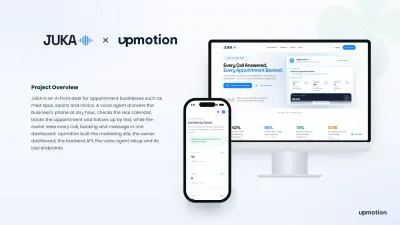 Case studyJUKAAn AI receptionist for med spas, salons and clinics. It answers every call, books into the real calendar, follows up by text and shows the owner every call in one dashboard.Read the case study
Have a project like this in mind?
Book a 30-minute call. We’ll talk through what you need, and you’ll know the price before any work starts.