We started Upmotion to fix the part of software projects nobody likes talking about.
A professional services team for strategy, engineering and AI, built on one simple promise:
“You know the price before we start, and you pay only for work you’ve accepted.”

Where it started
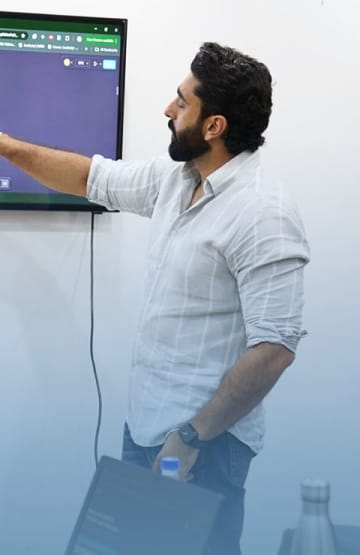
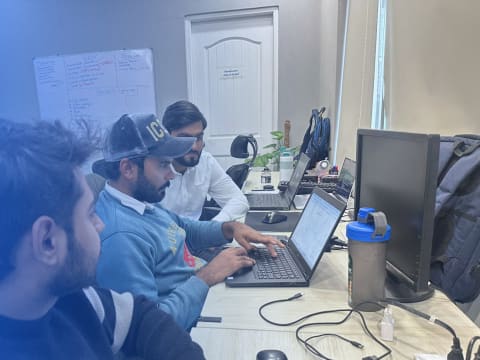
Before Upmotion, our founders spent years on the delivery side of software projects. They saw the same story repeat itself.
A company would bring in a development partner with a clear goal and a fixed budget. The partner would spend the first weeks learning the basics on the client’s time. Estimates would slip and hourly invoices would climb. By the halfway point, the conversation had shifted from “what are we building?” to “why is this costing so much more?”
The problem usually wasn’t talent. It was the model.
When a vendor is paid for hours, the risk of every delay, misunderstanding and change sits with the client.
In 2024, Unas Zubair started Upmotion to work in a different way.
A different deal
We made one decision that shaped everything after it:
“We would take on the
risk of our own estimates.”
Every engagement starts with discovery. We sit down with your team, understand the problem, and agree on the scope in writing. Then we put a fixed price on it, broken into milestones.
Each milestone ends with something working that you can see and test. You sign it off before you pay for it. If we estimated wrong, that’s ours to absorb, not yours.
This model forces discipline. We have to understand the problem properly before we quote it, and we can’t hide behind timesheets. It’s also why clients trust us with work that matters to them.
Every project made the next one faster
Our early projects were very different from each other.
LEAP.AI was a mobile platform that helps founders connect, collaborate and move forward.
Life-Skills was a mental wellness platform teaching practical life skills drawn from mindfulness traditions.
TriDooh was an AdTech dashboard for planning, managing and scaling advertising campaigns.
Then came work in healthcare, finance, retail, education and field operations.
Different industries, but each project left something behind: an architecture pattern that held up under real users, a component we had tested in production, or a lesson about where projects usually go wrong. We started capturing all of it in discovery templates, delivery playbooks, QA checklists, and reusable building blocks for authentication, payments, dashboards and AI integrations.
That’s why we say we’re productive from day one.
When we join your project, we don’t arrive with a blank slate. We bring what 90+ shipped products have already taught us, so your budget goes into your problem, not into our learning curve.
Some of that work grew into products of our own:
MedScript AI
for bilingual clinical documentation
LEAP.AI
for founder networking
AI Voice Agent
for customer operations
They’re proof that we don’t just build software for others. We build it, run it and improve it ourselves.



Going global
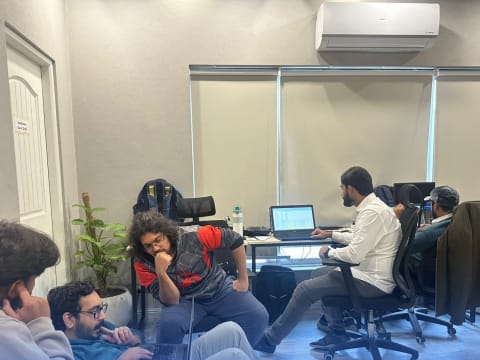
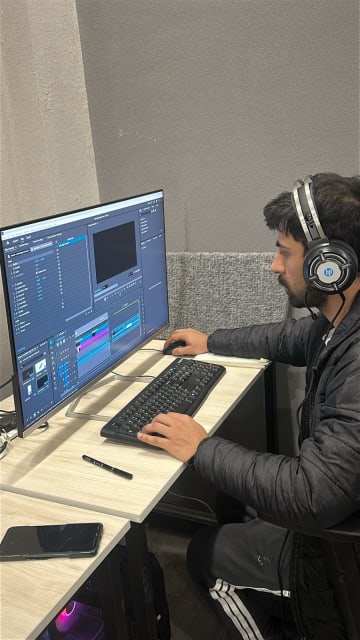
As our client base grew across the United States, Saudi Arabia, Canada, the UK and other countries, we built partnerships that put us closer to the businesses we serve:
Saudi Arabia
Supporting Arabic and English AI projects, WhatsApp Business automation, Oracle and Microsoft Dynamics support and Vision 2030 initiatives.
Canada
Local account management, CAD contracting and PIPEDA-aligned delivery for Canadian businesses.
United States
Local sales and discovery support, US contracting, and HIPAA-aligned delivery for healthcare clients.
What we believe
Price certainty is a form of respect.
You should know what something costs before you commit to it. We fix the price in discovery and stand behind it.
Nobody should pay for us to learn the basics.
We bring proven playbooks and tested building blocks from past work, so the first weeks go into your problem.
You own what you pay for.
All code, designs and IP transfer to you. We sign an NDA before discovery starts.
AI should work in production, not just in a demo.
We test AI against real data, keep people in the loop where mistakes are costly, and make sure users know when they’re talking to AI.